Response to Belgian (Breeder/Salesman?) Paul Vandenbussche (English Version)
Paul,
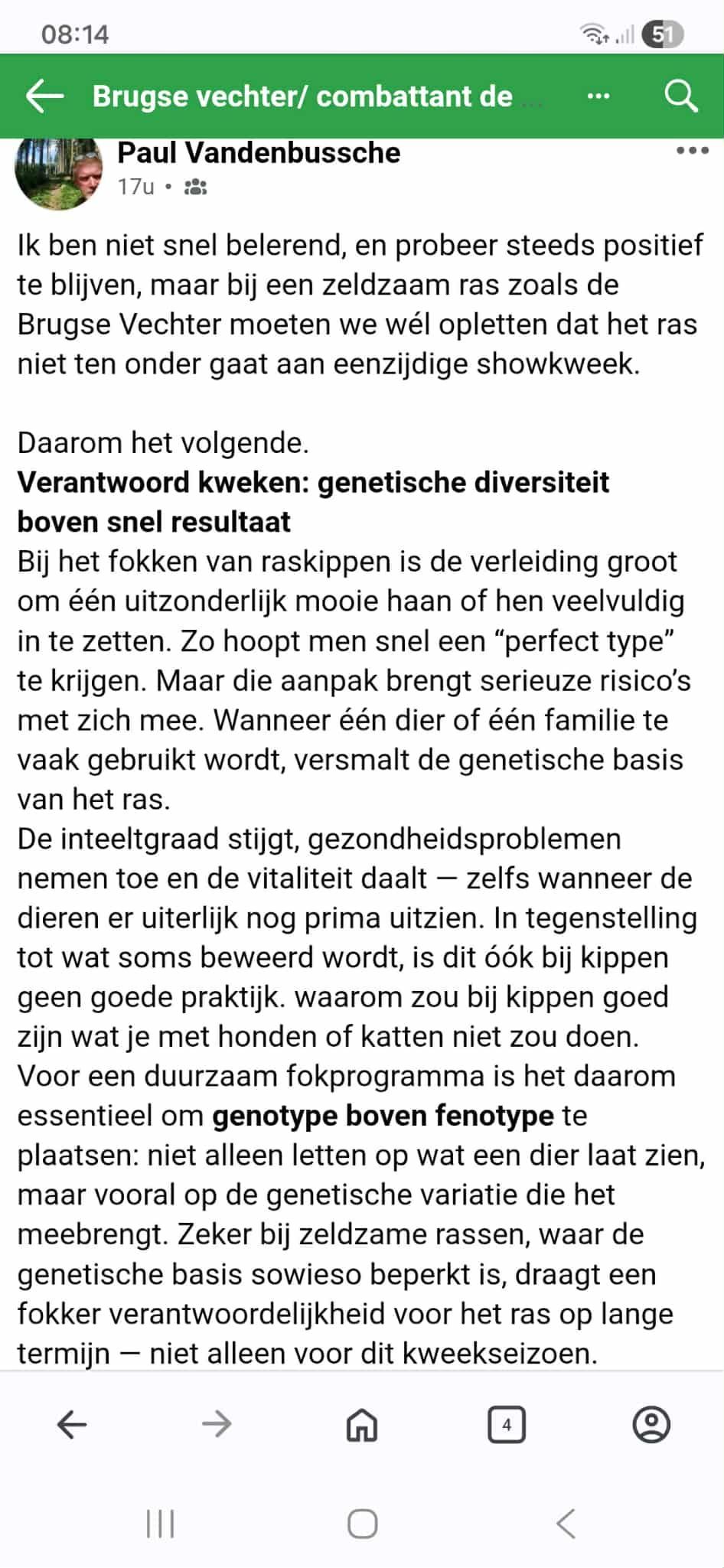
I appreciate that you want to draw attention to genetic diversity and responsible breeding — these are indeed crucial points for a rare breed like the Brugse Vechter. However, precisely because these topics matter so much, I find it important to address several issues in your message that do not align with what many breeders observe in practice.
1. It is difficult to preach genetic diversity while producing mainly quantity
You are currently the largest quantity breeder of Brugse Vechters in Belgium, supplying birds to every corner of Europe and the USA. That in itself is not a problem — if strict selection and culling are applied.
But when large numbers are produced without rigorous selection, quality inevitably suffers. This is visible at shows, where animals with your bloodlines frequently present issues such as:
- poor tail set
- excessively deep laying-type breast
- white nails and white toes
- narrow breast width
- excess colouring
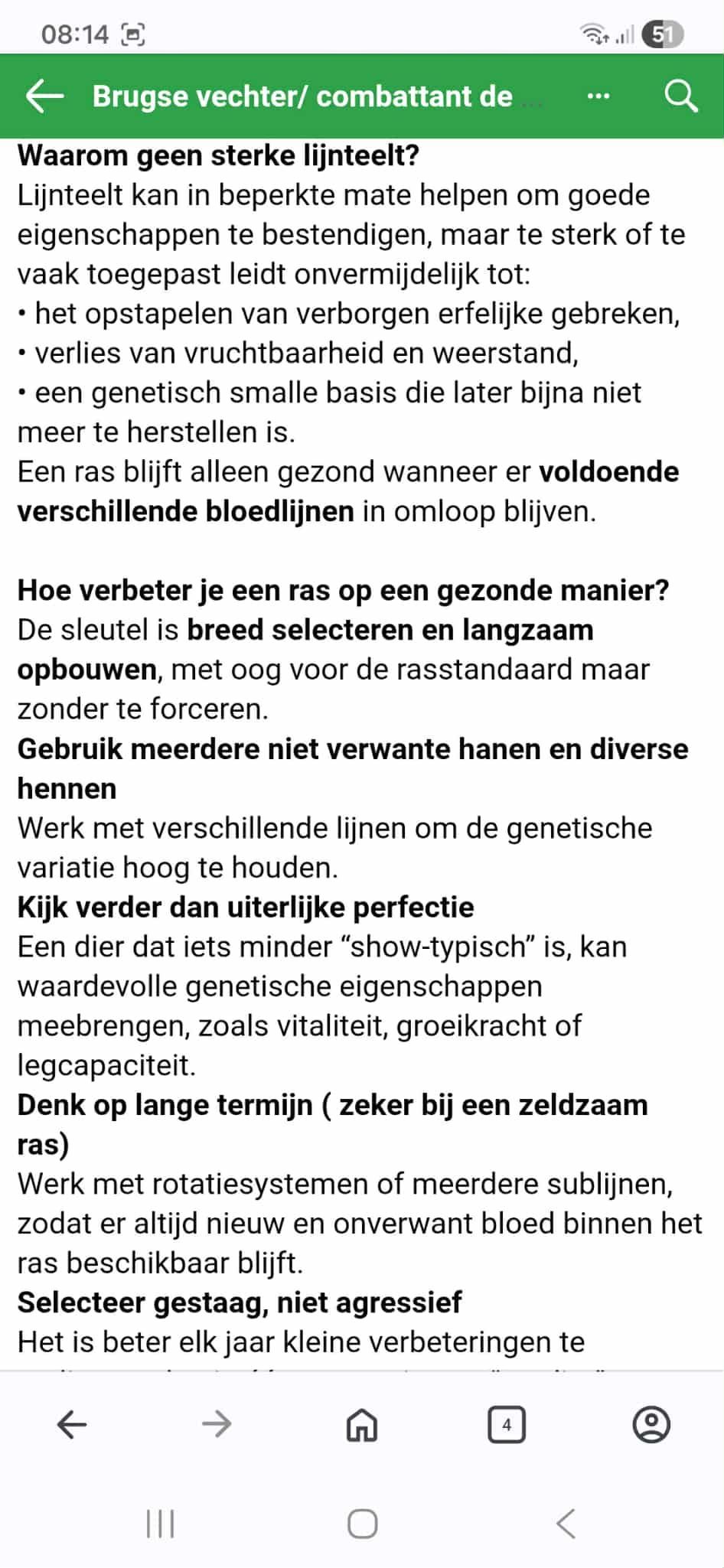
These faults persist across generations when they are widely distributed. It is therefore difficult to criticise others for linebreeding or selection practices when these defects repeatedly appear in animals from your own lines.
2. Steering inexperienced breeders towards your bloodlines harms the breed
New breeders often lack the experience to recognise quality and rely heavily on advice. If they are given birds that were not strongly selected or culled, this weakens the population and gives beginners an incorrect image of what a Brugse Vechter should be.
Responsible breed stewardship begins with honesty and quality — not with moving large quantities.
3. Your position has shifted completely in a very short time
Until recently, your own Ad-line was, according to you, the best line available — “full of potential supers.”
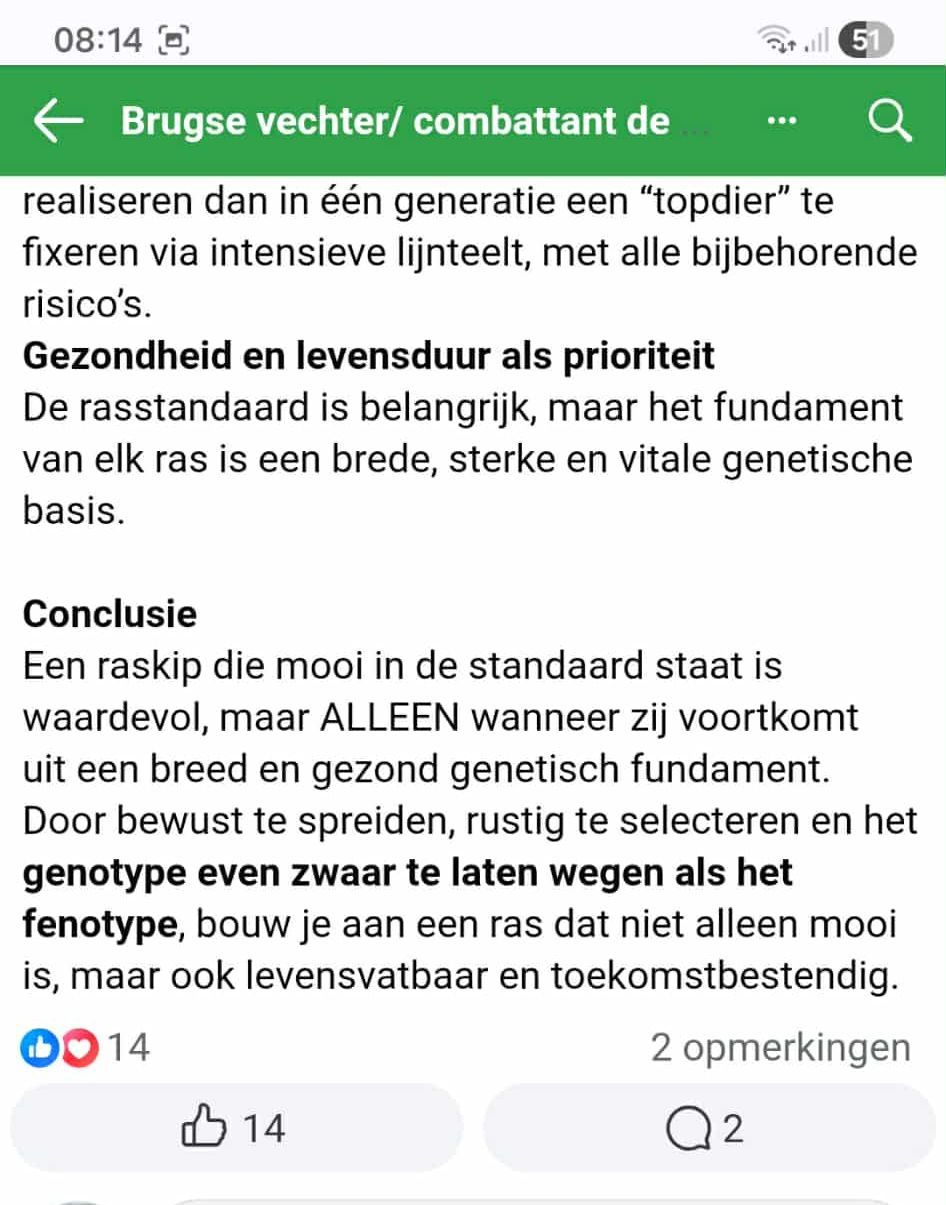
Now suddenly, the message is the opposite: genetic diversity and broad selection above anything else.
It is perfectly fine to change your views, but a complete reversal in theory raises questions when your practical breeding approach never changed accordingly.
4. I work with all existing bloodlines — and can therefore clearly see where real quality lies
I am currently the only Belgian breeder who actively maintains all bloodlines of the Brugse Vechter. This makes it very easy to see which lines hold future value and which ones consistently pass on structural faults.
And to be completely honest: birds that come directly from you are almost always of insufficient quality for what this breed deserves. When other breeders later combine and improve them, sometimes good results appear — but that is due to their selection, not your initial stock.
5. Genetic diversity is not an excuse to distribute poor quality
You are right that genetic diversity is important.
But diversity without strict selection is not enrichment — it is contamination.
Good breeders understand the difference:
- diversity + strong selection = improvement
- diversity + quantity breeding = decline
This distinction is essential.
6. Giving advice on show quality while never exhibiting your own birds is hard to justify
Another point that cannot be ignored is that you are the only Brugse Vechter breeder who never shows his own animals.
Shows are the place where:
- birds are judged objectively,
- faults become visible,
- and breeders learn and refine their selection.
If your own birds are never presented to be assessed by trained judges, it becomes difficult to position yourself as an authority on how the breed should be approached.
Closing Statement
If we truly want to strengthen the future of the Brugse Vechter, then theory and practice must go hand in hand: rigorous selection, honest communication, participation in shows, and real quality in the breeding pen. Talking about responsible breeding is one thing — applying those principles consistently is what truly matters for the health and future of the breed.
For the 2026 show season, my own colonial bloodlines will be present in Belgium, and I look forward to demonstrating the quality and strength of carefully selected breeding.
Regards,
Jean Kiala-Inkisi
President - African Ornamental Breeders Association (AOBA)
... and "New timer" Brugse vechter breeder.